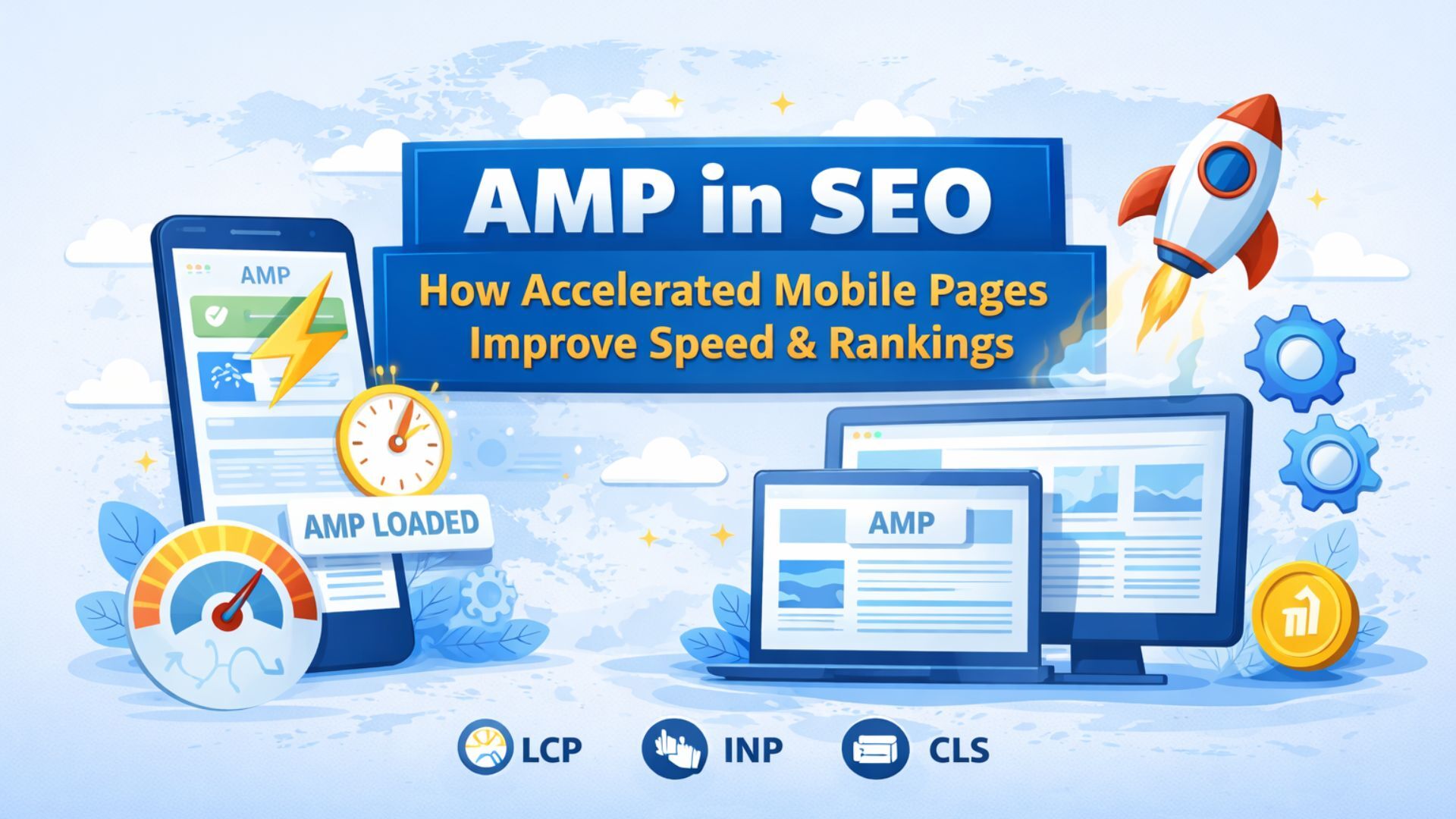
AMP (Accelerated Mobile Pages) is an open-source framework designed to make web pages load faster on mobile devices.
It achieves this by simplifying page code, restricting heavy scripts, and delivering content through optimized caching systems.
Fast-loading pages improve user experience and help websites meet modern search performance standards.
Understanding AMP (Accelerated Mobile Pages)
AMP is a performance-focused framework developed to improve the speed and reliability of mobile web pages. It reduces page complexity and ensures that content loads quickly, even on slower mobile networks.
The concept behind AMP is straightforward: simplify the page structure so that browsers can render content almost instantly.
Originally introduced for news publishers and media websites, AMP is now widely used across blogs, informational websites, and content platforms that rely heavily on mobile traffic.
The main objective of AMP is to create faster, lightweight web pages optimized for mobile users.
How AMP Works
AMP improves page speed through three core components that work together to optimize performance.
1. AMP HTML
AMP HTML is a modified version of traditional HTML designed to improve loading speed. It replaces certain standard HTML elements with optimized AMP components.
These components are pre-configured to load efficiently and avoid layout shifts.
Additionally, AMP restricts external CSS and requires styling to be included directly within the page with strict size limits. This ensures the browser can render the page faster.
2. AMP JavaScript
AMP limits the use of custom JavaScript to prevent scripts from blocking page rendering.
Instead of allowing uncontrolled scripts, AMP uses its own JavaScript library that manages page resources and ensures faster interaction.
This controlled environment prevents delays caused by heavy or poorly optimized scripts.
3. AMP Cache
AMP pages are delivered through a caching system known as the AMP Cache.
This cache stores validated AMP pages on content delivery networks (CDNs). When users access an AMP page through search results, the cached version is served instantly.
This process reduces server load and dramatically improves loading speed.
What Is the Purpose of AMP?
The primary purpose of AMP is to provide a faster mobile browsing experience.
As mobile internet usage continues to grow, slow loading pages can cause users to abandon websites quickly.
AMP addresses this challenge by improving:
- page loading speed
- mobile usability
- user engagement
- content accessibility
For websites that rely heavily on mobile traffic, faster page performance can improve visitor retention and content consumption.
What Is AMP in SEO?
AMP is not officially listed as a direct ranking factor in search algorithms. However, it supports SEO by improving several performance signals that influence rankings.
One of the key areas AMP improves is Core Web Vitals, which measure page experience.
These metrics include:
- Largest Contentful Paint (LCP) – measures loading performance
- Interaction responsiveness – measures user interaction speed
- Cumulative Layout Shift (CLS) – measures visual stability
By improving page performance and mobile usability, AMP indirectly contributes to stronger SEO outcomes.
Search engines prioritize fast and stable websites because they provide better user experiences.
Advantages of AMP
AMP offers several benefits for websites that prioritize mobile content delivery.
Faster Page Loading
AMP reduces unnecessary code and ensures pages load quickly on mobile devices.
Improved Mobile Experience
Users can access content faster, even on slower internet connections.
Lower Server Load
Serving cached versions of AMP pages reduces pressure on website servers.
Performance-Focused Structure
AMP enforces clean coding standards that improve overall page efficiency.
Limitations of AMP
Despite its advantages, AMP also introduces certain constraints.
Limited Design Flexibility
AMP restricts layout customization, which can limit creative page design.
Restricted JavaScript
Developers cannot use arbitrary scripts, reducing certain interactive features.
Dual Page Maintenance
Some websites maintain both AMP and non-AMP versions, increasing development effort.
Reduced Customization Options
Complex features or dynamic functionality may not work easily with AMP.
Should Websites Use AMP?
AMP works particularly well for content-driven websites such as:
- blogs
- news platforms
- educational websites
- informational resources
These sites benefit from faster loading and improved mobile reading experiences.
However, websites that depend on heavy interactivity, such as e-commerce platforms or web applications, may find AMP too restrictive.
Choosing whether to implement AMP depends on the website’s goals, functionality requirements, and development resources.
The Role of AMP in Modern SEO
As search engines continue prioritizing mobile-first indexing, page speed and usability remain important ranking considerations.
AMP helps websites meet these expectations by enforcing performance-focused standards.
While AMP is not mandatory for SEO success, it provides a structured approach to improving mobile speed and user experience.
For content publishers aiming to maximize mobile visibility, AMP can contribute to better engagement and stronger long-term search performance.
Conclusion
AMP (Accelerated Mobile Pages) is a framework built to improve mobile page speed and simplify web performance.
By limiting heavy scripts, optimizing page structure, and using caching systems, AMP delivers fast and stable web experiences.
Although AMP is not a direct ranking factor, it supports SEO by improving page experience metrics such as Core Web Vitals.
For blogs, news platforms, and informational websites that depend on mobile traffic, AMP can enhance usability, engagement, and search visibility in a mobile-first web environment.