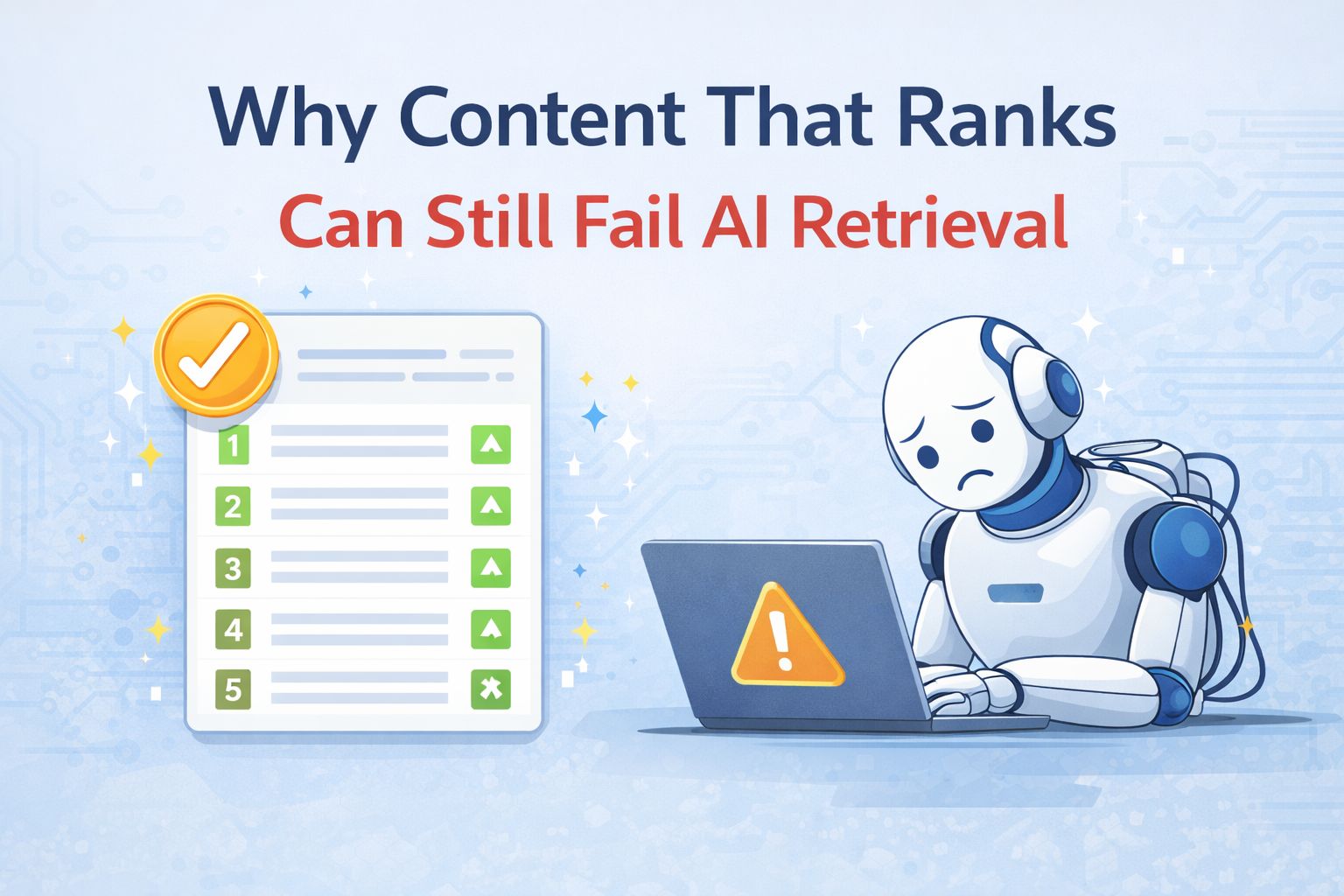
A page can rank on search, bring traffic, and still be invisible when someone asks an AI assistant a direct question. That disconnect confuses many teams. They see strong positions in search results, but they do not see their content being cited, summarized, or reused in AI-generated answers.
The reason is simple: ranking and retrieval are related, but they are not the same system goal. Traditional ranking rewards page-level relevance and authority signals. AI retrieval often rewards passage-level clarity, extractability, and semantic precision. If your most useful idea is buried in a long intro, wrapped in vague language, or mixed with too many topics, the model may skip it.
This matters even more for teams building content around daily conversation-based English learning. Learners ask short, practical questions like, “How do I stop freezing during conversations?” or “How can I practice speaking every day?” If your content does not provide clean, reusable answer blocks with clear steps, it may rank but still fail to appear in AI answers.
In this guide, you will learn exactly why this happens, how to diagnose it, and how to fix it with a practical system you can apply this week.
The Core Problem: Ranking Visibility vs Retrieval Usability
Think of search ranking as “Can this page deserve a click?” and AI retrieval as “Can this exact passage answer the question now?”
Both systems evaluate relevance, but retrieval has stricter constraints:
- It often works at chunk or passage level, not full page level
- It prefers explicit, self-contained statements
- It favors consistent entities and definitions
- It rewards easy-to-quote formats (steps, bullets, short explanations)
So if your page is authoritative but your key insight is scattered, the model has nothing reliable to lift.
A simple example
A ranking-friendly paragraph might say:
“Over time, consistent learner engagement can improve communication outcomes in real environments.”
A retrieval-friendly answer says:
“To improve spoken English confidence, practice one 10-minute real-life conversation daily and review instant feedback on grammar, clarity, and pronunciation.”
The second version is explicit, actionable, and answer-ready. That is retrieval value.
What Top Ranking Content Usually Gets Right
Across top-ranking pages on this topic, several patterns repeat:
- They separate ranking factors and retrieval factors clearly
- They explain structure, formatting, and intent alignment
- They include “how to fix” sections, not only theory
- They highlight trust and authority signals
- They use examples to show why AI skips otherwise good content
If your article misses these common blocks, it is less likely to satisfy both search users and AI answer systems.
Why Good Content Gets Skipped in AI Retrieval
1) Your best answer is not in the first retrievable block
AI systems often score compact segments. If your clearest answer appears after a long narrative, it may never be selected.
Fix: Put a direct answer in the opening of each major section. Then expand.
2) The page is multi-intent and semantically muddy
When one page tries to serve beginner questions, advanced strategy, product messaging, and news commentary together, retrieval confidence drops.
Fix: One page, one dominant intent. If needed, split into focused pages.
3) Definitions are implied, not explicit
Models need grounded entities. If you use terms like “conversation loop,” “feedback score,” or “fluency sprint” without defining them, passage understanding weakens.
Fix: Define each key term once in plain language and repeat consistent phrasing.
4) Formatting hides answerable units
Dense paragraphs reduce extractability. AI systems prefer segments they can map to direct question types.
Fix: Use short paragraphs, bullets, mini-FAQs, and step lists.
5) You optimize for keywords, not answer intent
A page may include the right terms but still miss the exact question shape users ask.
Fix: Build sections from real user prompts, especially question-led headings.
Primary Keyword Strategy for This Topic
Primary keyword: AI retrieval failure
Use supporting keywords naturally:
- why ranked content is not cited by AI
- retrievability in SEO content
- passage-level optimization
- AI answer visibility
- semantic clarity for content
Do not stuff these terms. Place them where they help comprehension.
A Practical Retrieval-First Content Framework
Use this framework for every article you publish in AI-powered English learning.
Step 1: Map daily conversation intent before drafting
Your audience does not search for abstract theory. They ask practical, emotional, and situational questions.
Common intent clusters:
- Daily practice plans
- Real-life conversation examples
- Instant feedback interpretation
- Confidence-building routines
- Mistake correction in live speaking
Start from these clusters, then define section goals.
Step 2: Write answer-first section openings
Each H2 should begin with a 2-3 sentence direct answer. Then add detail.
For example:
- Question: “How can I practice English daily if I am busy?”
- Retrieval-ready answer: “Use a 10-minute routine: 3 minutes speaking prompt, 4 minutes role-play, 3 minutes feedback review. Do this daily for 30 days to build confidence and fluency.”
This style improves both snippet capture and AI reuse.
Step 3: Use structured patterns AI can lift safely
Best formats:
- Numbered steps
- Decision tables
- Before/after examples
- Mini FAQs
- Definitions with one-line summaries
These patterns reduce ambiguity and increase citation probability.
Step 4: Build semantic consistency across the page
If you say “instant feedback” in one section, do not switch to “live evaluation,” “real-time correction,” and “speaking diagnostics” randomly.
Pick one primary label and maintain it.
Step 5: Add trust signals without bloating content
Include:
- Method transparency (how your recommendations were derived)
- Scope notes (who this method is for)
- Limitations (when this advice may not work)
- Update markers (last reviewed date)
Trust improves retrieval confidence because answer boundaries are clearer.
Retrieval-Ready Content Blueprint for English Learning Teams
Use this structure when writing long-form guides:
| Section | Purpose | Retrieval-friendly element |
|---|---|---|
| Clear intro | Match user intent quickly | 2-sentence direct answer |
| Daily routine block | Practical implementation | Numbered 7-day plan |
| Real-life conversation examples | Contextual learning | Scenario-based dialogues |
| Instant feedback guide | Clarify what to improve | Error-type checklist |
| Confidence building section | Emotional barrier removal | Progress milestones |
| Troubleshooting FAQ | Capture long-tail prompts | Short Q&A format |
| Action summary | Encourage execution | 5-step takeaway list |
This blueprint combines SEO depth and AI extractability.
Real-Life Example: Why a Ranking Page Still Loses AI Mentions
Imagine a page targeting speaking improvement.
It ranks well because it has:
- Good backlinks
- Strong domain trust
- Long word count
- Broad topical coverage
But AI systems skip it because:
- The core method appears only halfway down
- No explicit daily plan is visible in one chunk
- Conversation examples are generic, not scenario-based
- Feedback advice is vague (“practice more”) instead of diagnostic
Now compare with a retrieval-optimized version:
- First 120 words give a complete 10-minute routine
- Separate H3 sections for pronunciation, grammar, and response speed
- Real-life scripts for office, travel, and interview contexts
- Instant feedback loop explained with clear correction categories
- Confidence milestones for week 1, 2, 4, and 8
Same topic, very different retrieval outcome.
Content Gaps Most Articles Still Miss
Many articles on this topic explain retrieval mechanics, but skip learner behavior design. This is where you can win.
Gap 1: No conversation-to-content loop
Most pages do not connect real user conversations to future article updates.
Opportunity: Capture recurring learner questions from chat practice and convert them into new FAQ blocks weekly.
Gap 2: Weak feedback interpretation guidance
Many pages say “use feedback” but do not explain how.
Opportunity: Teach learners to tag each mistake as grammar, vocabulary, pronunciation, or hesitation. Then prescribe micro-drills by tag.
Gap 3: Confidence framework is missing
Confidence is often treated as motivation, not a measurable outcome.
Opportunity: Add confidence checkpoints: response time, number of turns sustained, filler-word reduction, and self-rating trends.
Gap 4: Little support for daily consistency
Advice is often ambitious and unsustainable.
Opportunity: Publish routines for 10, 20, and 30-minute schedules so users can stay consistent.
How to Optimize for Featured Snippets and AI Citations Together
Do these on every important page:
- Use question-style H2 headings
- Answer the question in the first 40-60 words below the heading
- Add one compact bullet list right after the answer
- Include one concrete example per section
- Keep paragraphs short and single-purpose
- Use plain, conversational English
For daily English learning topics, prioritize phrasing users actually speak:
- “How do I practice speaking daily?”
- “How can I get instant feedback?”
- “How do I stop feeling nervous while speaking?”
When your heading and answer mirror user language, retrieval quality improves.
30-Day Implementation Plan (Actionable)
Week 1: Diagnose
- Audit top 20 pages for answer-first structure
- Mark sections where key answers appear after 300+ words
- Identify mixed-intent pages that should be split
Week 2: Rewrite core templates
- Create a standard intro formula: direct answer + who it helps + next step
- Build reusable H2 patterns for daily practice, conversation examples, and feedback loops
- Add definition blocks for key terms
Week 3: Add retrieval assets
- Insert mini-FAQs from real learner questions
- Add one comparison table per long guide
- Add scenario-based dialogue snippets
Week 4: Measure and refine
Track:
- AI citation frequency for target questions
- Passage-level engagement (scroll depth and time around key answer blocks)
- Click-to-conversation conversion
- Confidence-related outcomes reported by users
Then update weak sections first, not entire pages.
Common Mistakes to Avoid
- Writing long intros before giving the answer
- Mixing too many intents on one page
- Changing terminology every section
- Repeating keywords without adding clarity
- Ignoring real conversation examples
- Giving feedback advice without correction workflows
If you avoid these, your content becomes easier for both humans and AI systems to trust.
Conclusion: Build Content That Can Be Found, Understood, and Reused
If your page ranks but fails AI retrieval, your problem is usually not quality. It is extractability, clarity, and intent alignment.
The fix is practical:
- Design for daily conversation intent
- Write answer-first sections
- Use retrieval-friendly formatting
- Add instant-feedback workflows
- Build confidence milestones into the content itself
When you do this consistently, your content stops being “good but hidden.” It becomes useful at the exact moment users ask for help, which is where AI retrieval decisions happen.
For teams focused on conversational English learning, this is the advantage: practical structure, real-life examples, clear feedback loops, and confidence-centered outcomes. That is how you create content that ranks, gets retrieved, and genuinely helps people improve every day.